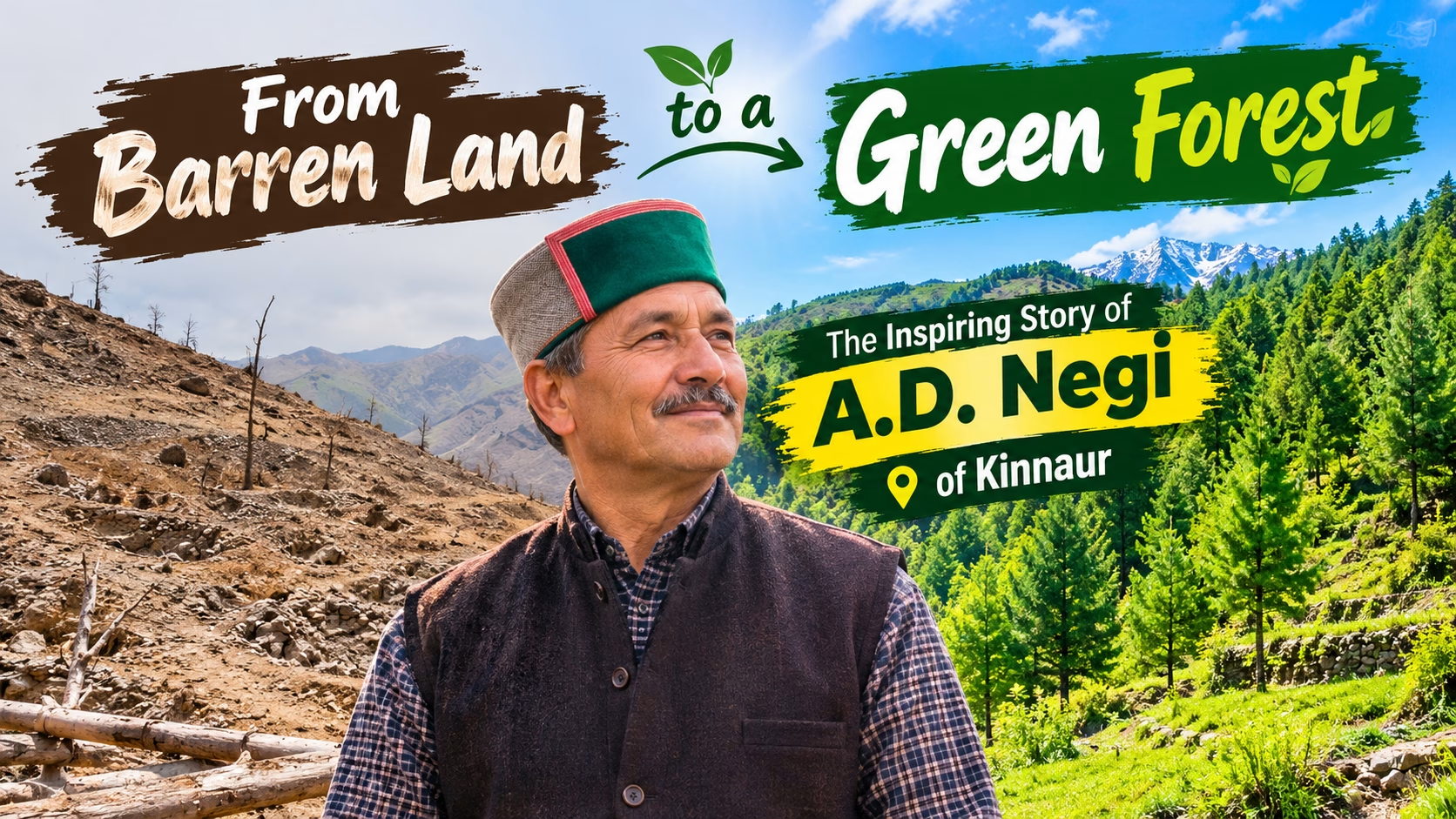
From Barren Land to a Green Forest: The Inspiring Story of A.D. Negi of Kinnaur
Kinnaur district of Himachal Pradesh is known for its snow-covered mountains, deep valleys, beautiful landscapes and rich cultural heritage. However, the upper regions of Kinnaur are also classified as cold deserts. These areas receive very little rainfall, face extreme winter conditions and have limited vegetation. Growing trees in such an environment is a difficult task. Yet, Anand Dhwaj Negi, popularly known as A.D. Negi, transformed a barren patch of land in Kinnaur into a thriving green forest through determination, patience and hard work.
A.D. Negi was a native of Sunam village in Kinnaur. He grew up close to nature and understood the importance of forests, water sources and traditional farming. During his early life, he observed that the natural vegetation of the region was gradually declining. Deforestation, soil erosion, water scarcity and harsh climatic conditions were affecting the local environment as well as the livelihood of villagers. This concern inspired him to dedicate his life to environmental conservation.
From Government Service to Forest Creation
A.D. Negi worked with the finance wing of the Desert Development Programme. The programme aimed to control desertification and promote development in the cold desert regions of Himachal Pradesh. During his service, Negi gained a better understanding of the environmental problems faced by high-altitude villages.
In 1998, he decided to begin an ambitious plantation project in the Thang Karma area. Instead of limiting his work to official duties, he started developing a forest on barren land. Thang Karma is situated in a remote and high-altitude region near Pooh in Kinnaur. The area receives very little rainfall and experiences strong winds, freezing temperatures and long winters.
Many people believed that developing a forest in such a difficult landscape was nearly impossible. Negi, however, saw the challenge differently. He believed that with suitable tree species, proper water management and continuous care, even a cold desert could be made green.
Planting More Than 20,000 Trees
A.D. Negi began his work by establishing a nursery. He selected tree species that could survive the cold, dry climate of upper Kinnaur. In the initial years, most of the plants failed to survive. Almost 80 percent of the saplings were damaged by extreme cold, strong winds, lack of water and animals.
Instead of giving up, Negi studied the reasons for failure and improved his methods. He experimented with different plantation techniques and provided special care to the young saplings. Over time, he succeeded in increasing the survival rate of the plants.
Various reports mention that he planted more than 20,000 saplings, while his wider efforts helped create a forest of nearly 30,000 trees in the region. His plantation included poplar, willow, wild apricot, robinia, juniper and other locally suitable species.
Slowly, the barren landscape began to change. The empty land was covered with green trees, attracting birds and small animals. The plantation also helped improve the appearance and ecological condition of the region.
Innovative Water Conservation Techniques
Water scarcity was the biggest challenge faced by Negi. In a cold desert, trees cannot survive without a reliable supply of moisture. To solve this problem, he used contour plantation techniques. Under this method, saplings are planted along the natural contours of the land so that rainwater and melting snow do not flow away quickly.
Negi also developed small channels, bunds and water-holding structures. These helped retain moisture in the soil and allowed water to reach the roots of the plants. Such measures also reduced soil erosion on the mountain slopes.
He used local materials to protect young plants from cold winds and harsh weather. Saplings were first strengthened in the nursery and then planted in the open area. This gradual process improved their chances of survival. According to reports, the survival rate of the plants eventually reached nearly 99 percent.
Negi also planted clover and other ground-covering plants. These plants helped retain moisture, improve soil quality and increase the fertility of the land. His work demonstrated that successful afforestation in high-altitude areas requires more than simply putting saplings into the ground. It requires careful planning, water conservation and regular maintenance.
Connecting Forests with Farming
A.D. Negi’s vision was not limited to planting trees. He wanted the project to benefit local communities as well. As the land became greener, farming activities also became possible in the surrounding areas.
Crops such as potatoes, peas, kidney beans, asparagus, sunflower and mushrooms were cultivated. Traditional fruit crops such as apples and apricots were also encouraged. This helped connect environmental conservation with rural development.
The forest improved the local microclimate, protected the soil and helped retain moisture. At the same time, it created opportunities for farmers to increase their income. Negi showed that afforestation can become a source of livelihood instead of being seen only as an environmental activity.
Inspiring the Local Community
In the beginning, many villagers were doubtful about the possibility of creating a forest in such a harsh region. However, when the plantation began to flourish, their attitude changed. Reports suggest that Negi inspired more than 200 farmers to develop their own land and participate in conservation activities.
He constantly reminded people that planting a sapling was only the beginning. The real responsibility was to protect and care for it until it became strong. He encouraged villagers to conserve water, prevent soil erosion and select tree species according to local climatic conditions.
His work became an example of how community participation can make environmental projects successful. Instead of imposing an outside model, Negi used local knowledge and involved people who understood the land and its challenges.
A Valuable Lesson in Environmental Conservation
The story of A.D. Negi is especially relevant in the present age of climate change. Himalayan regions are facing rising temperatures, shrinking water sources, changing snowfall patterns and increasing pressure on natural resources. In such circumstances, his work offers an important lesson: environmental protection is not the responsibility of governments alone.
An individual can also create meaningful change through consistent effort. Negi’s forest helped control soil erosion, improve water retention, provide shelter for birds and insects, and increase the green cover of the cold desert. It also demonstrated that difficult geographical conditions should not become an excuse for ignoring nature.
His approach combined traditional wisdom with practical scientific methods. He understood the local climate, selected appropriate plants and developed techniques suited to the landscape. This made his work sustainable and relevant for other high-altitude regions.
A Legacy That Continues to Live
A.D. Negi passed away in 2021, but his environmental legacy continues. He spent nearly two decades transforming a barren region into a green landscape. His efforts helped develop greenery across nearly 65 hectares of land in Thang Karma, making it an important example of ecological restoration in Kinnaur.
His life teaches us three important lessons. First, every major transformation begins with a small but determined step. Second, local knowledge and modern techniques can work together to solve environmental problems. Third, patience is essential when working with nature.
A.D. Negi did not merely plant thousands of trees. He planted hope in a landscape where vegetation seemed impossible. He proved that even a cold desert can become green when people work with dedication and respect for nature.
The forest created by him is more than a collection of trees. It is a symbol of courage, environmental responsibility and community development. His story reminds us that one person, one vision and years of sincere effort can bring life back to barren land.
A.D. Negi’s journey from a government employee to the creator of a forest is an inspiring example for everyone. His work shows that when determination is strong, even the harshest landscape can be transformed into a living, breathing ecosystem.
Leave a Reply