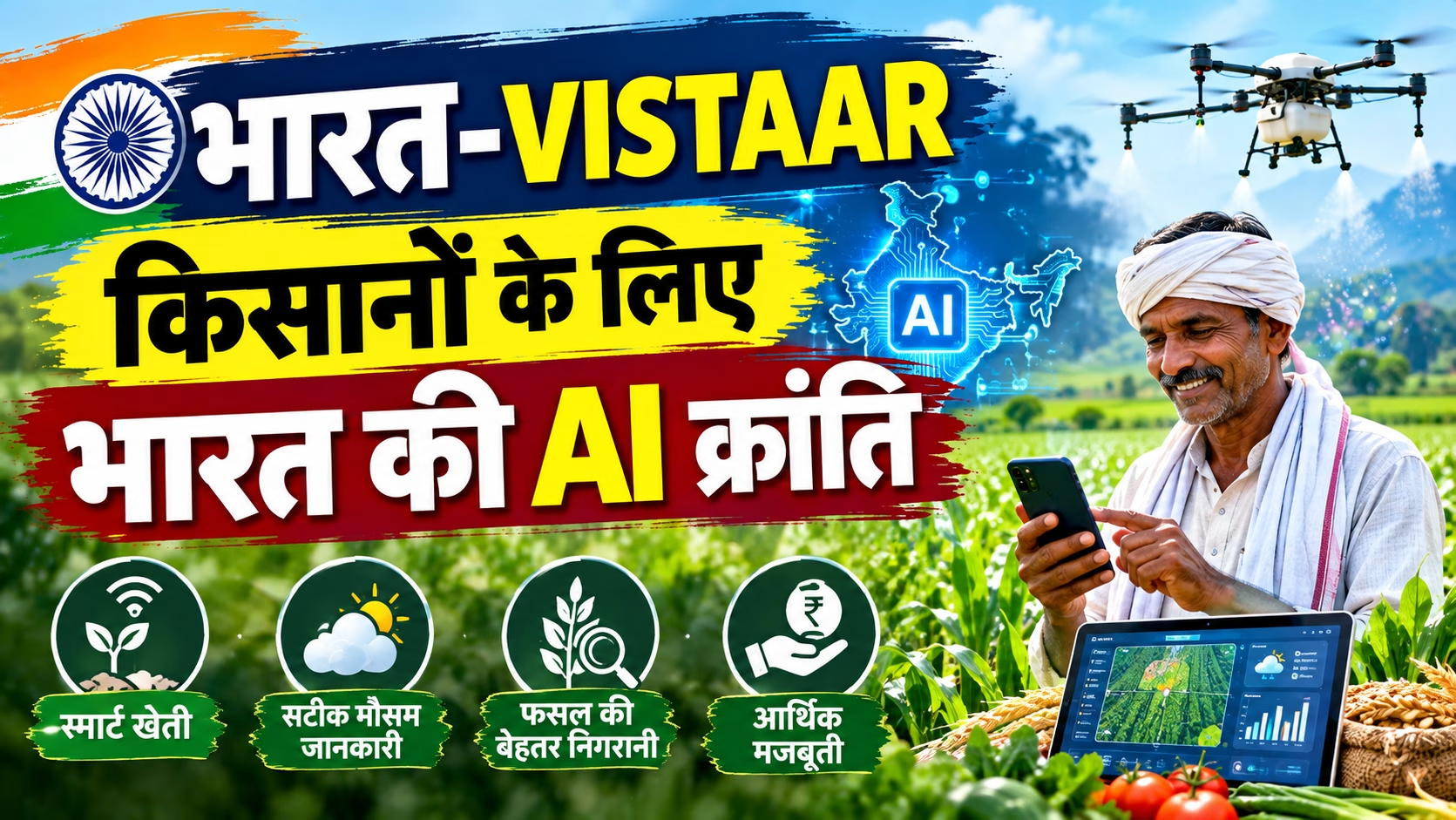
Bharat-VISTAAR: India’s AI Revolution for Farmers
Bharat-VISTAAR (Virtually Integrated System to Access Agricultural Resources) is India’s flagship AI-powered digital platform launched in Union Budget 2026-27 with ₹150 crore allocation to transform agricultural extension services for 140 million farmers. This multilingual Digital Public Infrastructure functions as a unified gateway connecting farmers to weather forecasts, market prices, crop advisories, government schemes, and grievance redressal through a single voice-based interface accessible on basic feature phones.
The platform’s core innovation lies in its voice-first AI assistant named “Bharati,” accessible via toll-free helpline 155261, enabling farmers to interact conversationally in their native language without requiring smartphones or digital literacy. Initially launched in Hindi and English across Maharashtra, Bihar, and Gujarat, the system will expand to 11+ regional languages in phases, ensuring inclusive access across India’s diverse linguistic landscape.
Bharat-VISTAAR integrates multiple critical agricultural databases including AgriStack portals, ICAR’s scientific farming practices, India Meteorological Department weather data, and real-time mandi price information from e-NAM. This integration allows farmers to receive personalised, location-specific advisories on crop management, pest and disease warnings with treatment solutions, soil health status, fertiliser recommendations, and optimal sowing/harvesting times based on local weather patterns.
Beyond technical advisories, the platform serves as a comprehensive scheme navigator, providing detailed information on 10+ major government initiatives including PM-KISAN (which has distributed over ₹4 lakh crore to 10 crore farmers), PM Fasal Bima Yojana for crop insurance, Kisan Credit Card for agricultural loans, Soil Health Card programme, and Agriculture Infrastructure Fund for post-harvest facilities. Farmers can check their PM-KISAN payment status, complete e-KYC requirements, understand scheme eligibility criteria, and receive application guidance through the platform.
Market intelligence represents another critical dimension, with real-time mandi price updates across India enabling better price discovery and informed selling decisions. The platform connects farmers to e-NAM’s pan-India electronic trading network, facilitating transparent auction processes and direct buyer linkages that can reduce middleman dependency and improve farm gate prices.
The 2026-27 Union Budget’s broader agricultural commitments complement Bharat-VISTAAR, including ₹1.32 lakh crore total agriculture budget, ₹1,70,944 crore fertiliser subsidy to reduce production costs, integrated development of 500 reservoirs and Amrit Sarovars for irrigation, and special programmes for high-value crops like coconut, cashew, and cocoa. These initiatives collectively address productivity enhancement, input cost reduction, and market access improvement.
Implementation challenges include rural digital literacy gaps despite voice-first design, internet connectivity issues in remote areas, need for continuous AI model training with regional agricultural practices, and coordination complexity across multiple government departments. Success depends on effective last-mile delivery through Common Service Centres, collaboration with Krishi Vigyan Kendras for ground validation, regular farmer feedback mechanisms to improve AI accuracy, and sustained investment in rural digital infrastructure.
Bharat-VISTAAR represents a paradigm shift from fragmented, one-way information delivery to integrated, interactive, AI-powered agricultural support. By democratising access to sophisticated agricultural intelligence regardless of device type or digital skills, the platform has potential to transform decision-making for millions of small and marginal farmers who constitute India’s agricultural backbone. If effectively implemented with robust feedback loops and state-level coordination, it could become a global model for AI-driven agricultural transformation in developing economies.
Leave a Reply